Nestled between the Pacific and the Atlantic Oceans, Costa Rica is a jewel well worth visiting. With such a wide variety of exotic sounding places, it was very difficult to choose what places to visit. Having spent months pouring over the Lonely Planet and various other guidebooks trying to figure out what we would manage to cram in in the the short amount of time we would have there, we finally settled on an itinerary which combined volcanoes, remote coastal areas and fantastic wildlife opportunities, knowing that whatever we left out would be equally as amazing. The trip was overall a brilliant adventure and comes highly recommended.


Los Jardines de las Cataratas de la Paz and the Peace Lodge

Following a rather long journey we landed in San José in the evening and were met, as planned with our tour operator, by our local contact. We were transferred to our hotel in the centre of the Capital, where we spent a comfortable night before being picked up again the next morning to head out towards the La Paz Waterfall Gardens on the slopes of the Poas Volcano. The trip was very interesting and took us past some coffee plantations. Our driver, Juan Carlos, stopped along the way to show us some plantations, telling us about the history of the coffee production, the necessary conditions needed to grow the best coffee and other interesting facts about the industry.

We finally arrived at the Peace Lodge and left out bags in a secure storage area at reception while we went to explore the private reserve. The place was amazing! We walked along private jungle trails, over little wooden bridged and gurgling streams, and then set about exploring the wildlife sections of the park. First the giant Aviary, with it's collection of tropical birds, including Toucans and Scarlet Macaws as well as many other natives species that have been saved from smugglers and sent here since they had become incapable of surviving in the wild. We then proceeded to the Butterfly farm, where we witnessed the birth process of the butterflies emerging out of their cocoons and spreading their fragile wings for the very first time before flying off to feed off the surrounding flowers.

Following the butterflies, we moved onto the Serpentarium, the reptile house, where we spent ages looking at the wide collection of poisonous snakes on display behind glass walls. I must admit that the Fer de Lance, a most poisonous and vicious looking snake if ever there was one, was significantly larger than I had expected, while the Pit Viper family were all a lot smaller than expected. Relived to have met all these slithery creatures in captivity, we then decided to follow the waterfall trail around which the park was based. The 5 impressive falls soared over drops, sending clouds of spray rushing in the air and flying all around us. A very refreshing walk to say the least!

Having finished visiting most of the park, we checked into out room. The room was absolutely stunning, with a king size 4 poster bed, its own hammock and Jacuzzi on the balcony (which overlooked the valley and the park), a waterfall in the bathroom etc. Pure luxury! We were absolutely delighted and really enjoyed spending some time relaxing in the Jacuzzi and in front of the fireplace.

After our rest, we headed out once more to visit the few remaining areas of the park, including the wild cat section and the humming bird gardens, where we were able to feed wild humming birds and have them land on our hands. These little birds are so fast and beautiful and we really enjoyed the opportunity this experience gave us to get up close and personal with the birds.

As evening came, we set out once more to visit the Ranarium (frog house). To be fair, we had walked through this during the day and found the frogs fairly uninteresting as they simply hung camouflaged under some leaves. Our night visit was however totally different. The tree frogs were awake and singing, jumping around and showing off their colourful undersides. Our guide was very informative and told us about the particularities of several different species. We were fortunate enough to be allowed to handle a frog which was an experience in itself! After about an hour hunting for frogs in the dark, we went to the hotel restaurant where we share a sumptuous 3 course meal. The portions were generous and the food was fantastic.

If ever you visit Costa Rica, don't miss the La Paz Waterfall Gardens! And as the Lonely planet says, if you are there with your partner and there is even an ounce of love between there, spend the night in the Peace Lodge!
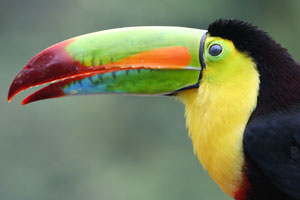

Toucans
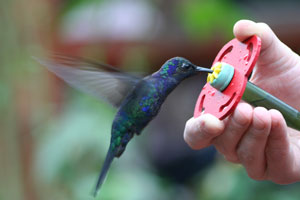

Feeding Humming Birds
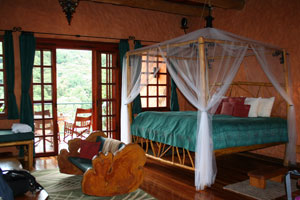

Our room at the Peace Lodge
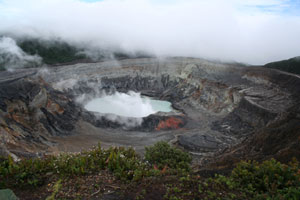


Poas Volcano

We visited the Poas Volcano on the way from La Paz to Monteverde. The rain was sheeting down as we arrived and the main crater was covered in a thick blanket of impenetrable cloud. We decided to walk to the second crater, a little smaller than the main one and home to a lake. Just as we arrived there the clouds dissipated and we were able to appreciate the size and beauty of the location. Having spent a few minutes enjoying this view, we then rushed back to the first crater, in the hope that the wind was also clearing the clouds over this one as well. And fortunate we were! The clouds lifted just as we returned, revealing the stunning crater of the Poas Volcano. The crater was much larger than I had expected, and in the base of it there was a pale yellowy-blue lake of water, steaming away from the heat of the volcano before. Apparently the water levels have been going down recently and geologists see this as a sign of a possible eruption.

The information office had an interesting museum with photos and articles about the history and eruptions of the volcano and it's past activity. 


The Main Crater


Monteverde Cloud Forest

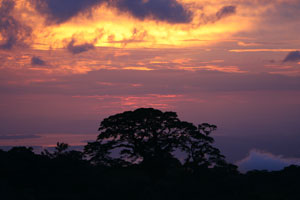
To reach Monteverde, the road takes us along 35km of unpaved dirt tracks, winding steeply into the mountains and offering ever-more spectacular views along the way. As the mountains rose steeply from the valleys, toucans and parakeets started to appear on the road side, chirping away at each other as they flew around in large playful groups. We arrived at our hotel during the afternoon and settled into our room. Wandering around at dusk, we were treated to a spectacular sunset over the cloud forest, listing to the emerging songs of frogs and other night creatures.

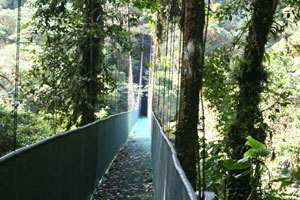
The following morning we woke up early and set out on an adventure sky walk on hanging bridges strung out among the canopy and stretching out over ravines. The initial bridge was quite a steep climb up and our guide stopped in the middle of it, leaving us swaying in the wind and rain, wondering if the rest of the trip would feel as perilous and insecure! Fortunately, the weather changed, and our guides took us on an interesting tour of the canopy, finding a variety of plants and animals (including red kneed tarantulas) and telling us all about the complex ecosystem of the forest. The end of the trail lead us to a humming bird garden. Once again we spent some time gazing at these pretty little creatures as they buzzed around frantically from feeder to flower and fluttered around each other in graceful displays of aerial acrobatics.

The afternoon we spent in the Monteverde Cloud Forest reserve itself, walking along some of the many trails on offer. Here the terrain was a little more challenging, and the climate a little more intemperate. We were lucky to spot a pair of Quezal feeding off a tree in the forest, and also saw a lonely Coatimundi wandering around the forest close to the ranger system. It was very nice to get an opportunity to walk around the forest on our own and we enjoyed the opportunity this gave us to stop and just enjoy the forest and its many fascinating plants and little animals, including several sloths and a variety of colourful birds.


Sunset over the cloud forest


Skywalk


Manuel Antonio National Park

Arriving at the Costa Verde hotel in Manuel Antonio from the cloud forest was like walking into a steaming hot sauna dressed in a ski suit in the middle of winter. With sweat dripping off our faces, we were grateful for the relief that the air conditioning in our spacious room offered, and decided to hide away there to recover from the heat for a while before going out to explore our surroundings. Having cooled off slightly, we proceeded to walk down the hill to the public beach where we sat in the shade of a tree and swam in the sea. The warm water trickling over our feet and the soft sand of the never ending beach were just the right touch for such a hot day! Having walked back to the hotel a little more refreshed, we were able to appreciate the fantastic rooms that both our balcony and the hotel restaurant had to offer over the bay. As we were busying ourselves with the view, a troupe of endangered Titi monkeys started jumping through the hotel, bouncing playfully from tree to tree, climbing over the balconies of the rooms and using balustrades as a fireman's pole before bouncing back off up the nearest palm trees. These cute little monkeys seemed to be regular visitors and their late afternoon exuberance was described by the hotel staff as "monkey hour".

After a very satisfying meal in the hotel restaurant, overlooking the bay and the fantastic sunset over the Pacific Ocean, we realised that the heavens had opened and ran back to our room as fast as our legs could carry us. The rain poured down for the rest of the evening, but we were able to sit our on our balcony watching the curtains of water flow down over the dense vegetation surrounding the hotel. The night felt incredibly peaceful with the rain continuing into the early hours of the morning.

The next day, I woke up to find that one of the titi monkeys had decided to shelter on the balcony overnight, where is was tightly curled up in a ball, sound asleep, with it's tail curled over its body and face. Sleepy eyes peered out at me from under the tail, and having decided I was obviously not a threat, the little monkey decided to stay where he was while we got ready to go and visit the National Park.

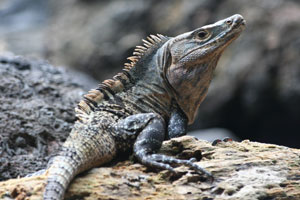
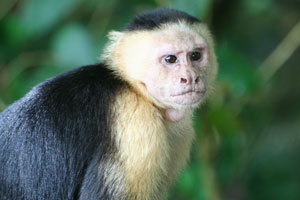
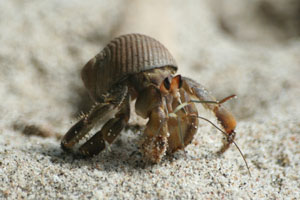
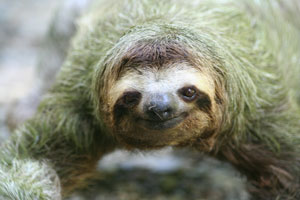
Having decided to not take a guided tour of the park, we were approached on several occasions on our way to the entrance by independent guides and park rangers offering their services. Having forded the small river, we finally reached the entrance of the park, unaccompanied, and promptly came across the largest Iguana that I have ever seen in my life. Further up the path, we bumped into Mike and Steve, who we had previously met in both the plane during our flight to Costa Rica, and in our hotel at Monteverde. Fortune decided that we would keep bumping into them, so we decided to meet up that evening for a meal at the local restaurant, "El Avion". We continued along the path, leaving our friends with their guide, and immediately came across an armadillo foraging in the undergrowth. A few Iguanas, some Jesus lizards, a multitude of hermit crabs and a couple of birds later and we finally met our first white faced capuchin monkey, who was promptly followed by the rest of his rather large family. The monkeys were real posers, jumping around the trees around us, posing for photos on low branches and stealing food off each other as they bounced around. we continued our visit of the park, walking all the less travelled trails, meeting wildlife all over the place, be it iguanas, humming birds, monkeys or a whole variety of other inhabitants of the path. After a nice pause and a swim on the beach (and a nasty invasion of ants) we started to walk towards the exit. Having up until then failed to get a really close look at a sloth (most of them were very well hidden up the top of trees) we were treated to an incredible sight: A sloth slowly climbing out of a tree, tumbling down onto the road, crossing the road on all four hands, and then climbing back up a tree on the other side. The process was of course very slow, but yielded some pretty good sloth pictures!

Our evening meal with Mike and Steve at El Avion was interesting and merry. The restaurant is named for the Fairchild C-123 which it is based around. The plane was part of one of the biggest scandals in the mid 1980's. During this time, the Reagan Administration had set up a bizarre network of arms sales to Iran designed to win release of US hostages being held in Lebanon and raise money to fund Nicaraguan counter-revolutionary guerilla fighters, commonly referred to as the "Contras." By artificially inflating the prices of the arms, NSA official Oliver North, was able to reap profits that could be diverted to fund the counter-revolutionaries of the Cuban allied Sandinista government. Of the $16 million in profits raised, only $3.8 million actually funded the Contras. With the CIA's help, they purchased several items, including two C-123 cargo planes (one of which is the plane which now sits by the side of the road in Manuel Antonio), two C-7 planes, a Maule aircraft, spare parts, and munitions. They also built a secret airstrip on an American-owned, 30,000 acre ranch in northwest Costa Rica. On October 5th 1986, a US cargo plane (the twin sister of the plane currently sitting in Manuel Antonio) was shot down over southern Nicaragua. One of the crewmembers, CIA operative Eugene Hasenfus, parachuted to safety and was captured by the Sandinista army. Led out of the jungle at gun point, Hasenfus's very existence set in motion an incredible chain of cover-ups and lies that would mushroom into one of the biggest scandals in American political history and is known as the Iran-Contra Affair. As a result of this successful Sandinista strike on the Fairchild, the cargo operation was suspended and one of the C-123s was abandoned at the International Airport in San Jose. In August 2000, the current owners of the restaurant purchased the abandoned Fairchild for $3,000. It was then disassembled and shipped in pieces to Quepos. After hauling all seven aircraft sections up the Manuel Antonio hill, the C-123 finally found its current cliff-side resting-place and houses a restaurant and bar. The food here was tasty and the views over the bay were stunning.

The next morning we set our for a ride, with Mike and Steve, through the surrounding hills and to a waterfall. Here we saw toucans and poison dart frogs and had a swim in the waterfall. The return journey along the riverbed was fun and everyone got very wet! We spent the afternoon on the beach once more, walking along the water's edge and savouring the calm atmosphere of the sea. That evening we returned to El Avion for a final time before heading back for a last night in our comfortable air conditioned room.


Iguana


White Faced Capuchin


Hermit Crab


Sloth


view from the Costa Verde


Drake Bay and the Corcovado National Park  


Cano Island  


Flying with Nature Air

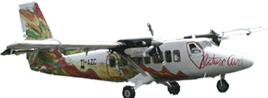
Nature Air is a fairly young company with a fleet of small 19 passenger Twin Otter Vistaliner aircraft. They operate in Costa Rica and neighbouring Panama and claim to be the first carbon-neutral air operator in the world. Our flights with Nature Air were quite an adventure in themselves. Think Jurassic Park and that will probably give you an accurate vision of the planes landing on the remote jungle runways. Despite the many apprehensions over flying with a small Central American company, and visions of tabloids splashing the death of two English holidaymakers in a plane crash in the remote Costa Rican jungle on their front pages, I was very relived to get on some very nice planes. The journeys were short, very smooth, and the pilots were very professional. All in all a great relief and an experience I would now be happy to repeat! For more information about the company visit http://www.natureair.com


Costa Rica Experts 

Costa Rica Experts did a fantastic job organising our tour to our specifications. Everything ran like clockwork and the local staff were friendly, informative and helpful. For more information about the tours visit www.costaricaexperts.com

If you liked the story of our trip in Costa Rica, you may also like to read about our travels in other countries:
Argentina Brazil Paraguay Tunisia
Webpage created by Claire Rossiter - 2007