Despite being a small country, Tunisia is packed full of interesting sites for the adventurous tourist. From sandy beaches and tourist resorts to the depths of the Sahara desert, there is undoubtedly something here for everyone. Having come to Tunisia to visit some friends who are currently living and working in Tunis, we took the time to hire a car and hit the road for a few days. Our visit corresponded with the start of Ramadan, a traditional Muslim fast whereby it is forbidden, among other things, to eat, drink or smoke during the day. This meant that it was a little more difficult for us to find places to eat during the day, but this potential problem was overcome by a constant supply of biscuits and quantities of food in the evenings.


Monastir Click Here for photos of Monastir

Having met Sarah at the airport upon arrival, collected our hire car (a Renault Clio) and passed by her house for a quick bite to eat, we headed straight out of Tunis in the direction of Monastir. The drive was fairly uneventful and we arrived in good time to start searching for a hotel. After a few false starts, we eventually found a very nice little hotel-apartment on the marina.

The following day, after a lazy start, we headed out towards the Ribat (fort), where we found an Italian film crew busy filming the latest Italian Roman epic. The Ribat, which is preserved in excellent condition, was full of little passageways and staircases. As we explored the building, we watched the Italians filming in the court yard below. The props in the corridors gave an interesting view of what the Ribat would have looked like when inhabited.

Walking out of the Ribat, we headed into the old walled town, looking for somewhere to eat. We eventually found a nice little café on what appeared to be the main square. Here we had a small refreshing bite to eat, looking out over the hustle and bustle of the street. We then had a quick tour of the small souk before heading back out of town to the beach.


Sunset over the Sea - Monastir


Inside the Ribat


El Jem Click Here for photos of El Jem

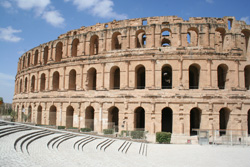
Our road from Monastir to Matmata led us straight past the impressive ruins of the El Jem Colosseum which towered over the skyline and was visible from miles away. Having paid the statutory Dinar to a guy looking after the car park, we then proceeded to walk around the Colosseum towards the impressive entrance. Dwarfing every building in its surroundings, the feelings of grandeur increased as we entered into the bowels of the monument. A string of corridors and passageways snaked around and beneath the centre arena, revealing the secrets of a time gone by. It is easy to picture the gladiators waiting here to rush into battle. Climbing up the stands and the myriad of staircases, we gradually rose through the beautiful other-worldly arches of the corridors to the upper echelons of the stands, from where we were treated to a birds' eye view of the central arena and the spectacular surrounding countryside.


Colosseum at El Jem


Matmata Click Here for photos of Matmata

As we gradually got closer to Matmata, the surrounding countryside shifted gradually from the monotony of the olive growing plains to a more interestingly barren mountainous terrain. With the evening sun catching the hilltops, it was as if we had entered a new world. Slowly we wound our way up to the village in the hope that we would find a hotel with no trouble.

On arriving in Matmata, we were immediately faced with groups of suicidal young Tunisia men, randomly jumping out in front of our car in the hope that we would stop and offer them some money to show us where o find a hotel. Having avoided the more insistent specimens, we finally let one of them guide us to the Hotel Matmata, where we decided to spend the night. The hotel was very clean and comfortable, offering a choice between both “standard” rooms and “troglodyte” accommodation. We opted for the latter and were not let down.

After a good nights sleep and a copious breakfast, we headed out to visit Matmata with the young man who had shown us the hotel the previous evening acting as our guide. He kindly took us around the ancient troglodyte pit home, originally built here by the Berbers in order to escape the heat of summer. We were invited into one of such homes where an old lady was making bread and grinding couscous down for her family.

We next headed for the famous Sidi Driss hotel, used in the original Star Wars movies as the interior of Luke Skywalkers’ home. Here we found bits of the original set still in place. It is easy to see how such terrain and environment inspired George Lucas to use the area in his films.


Star Wars Pit Home


Making Couscous


Ksar Ghilane Click Here for photos of Ksar Ghilane

Our trip into the desert started in Douz, where, after having rung around several tour operators, we set off with our guide in a 4x4. As we left the Douz-Matmata road, heading South along what is known locally as the pipeline road, the scenery around us gradually started getting more and more deserted. Our guide, who seemed to have a thirst for speed, stormed along the road at breakneck paces which did not decrease when the tarmac finally ran out. Mercilessly, he ploughed through sand drifts, dodging the occasional vehicle coming the opposite way, sending us bouncing up and down. Our seat belts seemed to be keeping us in contact with the seat more often than not. Thankfully he avoided the heard of dromedaries that appeared before us on the road, even stopping long enough for me to take a couple of pictures.

On arrival at the Ksar Ghilane Oasis, we deposited our bags in our tent and then headed our towards the "dromedary rank". Here we were introduced to the dromedary that were, for the next 2 hours, to traipse trough the desert through a sand storm with us on their backs so that we could visit the ancient Roman fort of Tisavar, a crumbling vestige of the Limes Tripolitanus defensive line. With the sand storm raging around us, we were able to appreciate the practicalities of the old Berber head scarves and the protection that they offered against the elements. Our dromedary were a pair of friendly animals. The movement was fairly similar to that of a horse, although mounting and dismounting was not quite as smooth.

Following our dromedary ride, we took a refreshing dip in the local hot springs and then headed back to our tent to get dressed for dinner. By this time, the southern wind was starting to diminish, as our dromedary guide had predicted. Had it been a northern wind, we would have been blasted all night. The meal they served us was filling and satisfying. A trip out onto the dunes to watch the stars in the open sky above provided a perfect ending to the evening..... or not..... indeed, as we were getting ready for bed, Rob found a scorpion in our tent. Having alerted me to this, I then pointed to what I thought was now a dead scorpion on the ground and said, "That?" At this point, Rob realised that we in fact had two scorpions in our tent. They were promptly dealt with, our bags checked and the lights turned out.

After a sound nights sleep, free of scorpion dreams, we rose early and went for a short stroll among the sand dunes. The desert was a massive contrast to the windy sand storm of the previous day and, instead, was the picture perfect postcard scenery that we had all dreamed about. Following our stroll, we had breakfast and embarked on the perilous 4x4 drive back to Douz.


Our guide leading our dromedaries away


Sand dunes in the Sahara


Tisavar on the Limes Tripolitanus Line


Chott el Jerid Click Here for photos of the Chott El Jerid

Leaving Douz and the Sahara behind us, we headed towards Tozeur on the Kebili-Tozeur road, following the highway over a long causeway straight through the Chott El Jerid. This immense salt lake covers an area of around 5000km2 and can offer some spectacular views which many will be familiar with as it was here that George Lucas filmed the scene where Luke Skywalker contemplates the two moons of Tatoine in the first Star Wars movie. About half way along, we stopped for a brief walk onto the salt flats and some close up shots of salt pools. The scenery was desolate, and with very few cars coming along the road, we were surrounded by total silence.


Chott El Jerid


Sidi Bouhlel & the Star Wars Canyon Click Here for photos of Sidi Bouhlel and the Star Wars Canyon

Following a detour in Tozeur and a quick tour of the famous Palmaraie, we headed back on our tracks a little in search of the famous Star Wars Canyon, conveniently located in a remote location the no one had heard of. Fortunately, after a few blank looks, we finally found someone to indicate the way. The road we followed petered out into a dirt track and opened out onto a big flat area in which we parked the car.

Having decided to walk around in search of the canyon, we quickly found another young Tunisian to guide us around this impressive landmark. He dutifully showed us all the film locations, describing scenes, shots and camera angles along the way. The canyon was beautiful with steep impenetrable sides and had a large windy bed. It was here that R2D2 got kidnapped in the first Star Wars film, where Luke was attacked by Tusken raiders, were Jawas parked their sand crawlers, and, a little further on, where Ben Kanobi and Luke overlook Mos Eisley. Our guide was able to show us where all these scenes were filmed, and also described a number of shots filmed here for other movies, such as The English Patient.

Climbing out of the canyon, we visited the temple of a local Marabou. Here, local came to pray and ask for favours, such as luck in love, cures for illnesses etc. The views from the top of the building were striking, opening out onto the spectacular scenery of the Chott El Jerid.


Star Wars Canyon


View from the Marabou temple


Tamerza & the Mountain Villages Click Here for photos of the Tamerza

Having decided not to spend the night in Tozeur, we headed North once again, along roads a little less used, in the direction of the mountains and the small village of Temerza. The road stretched out in front of us towards an imposing chain of mountains that rose up from the arid plains. Around us, herds of dromedaries littered the countryside, providing ample photo opportunities.

On one such photographic foray, Robert decided that the car needed to be a little further off the road, in order to avoid being hit by the regular convoys of 4x4 that passed along the road. Unfortunately, the side of the road was not quite as firm as anticipated, and within seconds our car was buried in the sand. As we sat there covered in sand, wondering how we were going to get out of the mess we had got ourselves into, a 4x4 full of policemen drew up beside us. The very friendly commander examined our predicament with a log of nodding and chuckling, and then, with a click of his fingers, ordered his subordinates out to help us. Together, they lifted (yes, lifted) the car out of the sand and back onto terra firma. With a friendly wave they all disappeared back into their vehicle as fast as they appeared, no doubt chucking all the way about the stupid tourists they had just helped get unstuck from the sand!

As we wound our way up the mountains, the views became more and more spectacular, stretching out over the plains and the Algerian border. Finally, after a long steep climb, we reached Temerza and set out on the search for a good hotel to spend the night in. We successfully found the Hotel Temerza Palace, where, after a lot of bargaining, we finally managed to get a room in at an affordable price. The hotel was fantastic. Set up the hillside, it looked out over the palmaraie and the shell of the old walled town of Temerza, (now vacated following torrential rains which decimated the mud buildings back in 1969). Having set our bags down, we quickly grabbed our towels and rushed out onto the terrace to have a relaxing swim in the hotel pool before heading in for a succulent dinner.

The following morning, following a very good night’s sleep, we set out to explore the area’s waterfalls and cascades. The settings were fantastic, although hordes of souvenir shops crowd the access and bus loads of tourists somewhat ruined the overall feel of the locations.


Mountain view


Old walled town


Sufetula Click Here for photos of Sufetula

Leaving behind us the hidden delights of the mountains, we once again headed out across the plains, this time driving in a north easterly direction as we followed the road back to Tunis. The scenery around us once again became littered with line upon line of olive trees, growing steadily greener and more fertile as we went along.

We arrived a Sefutula, next to the modern town of Sbeitla, with about 30 minutes to go before the gates were due to close. The impressive ruins, which lie next to the main road, are impossible to miss. We walked around the cobbled streets, passing bath houses and olive presses, stopping off at the theatre and then walking up towards the impressive Antonine gate which opened onto the forum. The ruins themselves were in a very good state of preservation and restoration work was visible all around.


The Forum


The Bardo Museum & the Tunis Medina Click Here for photos of the Bardo Museum and the Medina

Back in Tunis with Sarah and Guillaume, we decided to spend one of our last days in Tunisia exploring the Bardo Museum and the Medina. The museum houses many of the mosaics found in all archaeological sites around the country. As we wound our way around the rooms and stairways, we saw a myriad of colours depicting various gods, hunting scenes, animals and other such important aspects of Roman society.

Having had our full of mosaics, we then headed to the Medina where we wandered around the souk, besieged by men wanting to sell us their products at extortionate prices, all promising to bring down their prices. The bubbling streets were full of colour, people, noises and smells which contributed to a vibrant atmosphere. Having meandered around we eventually found our way back to the point we had started out from without having parted with too much money!

That evening, we went out to a very smart restaurant set in an 18th century palace(The Dar El Jeld, for those in the know),with Sarah and Guillaume where we broke the Ramadan fast with a traditionally rich and succulent meal.


Inside the Bardo Museum


Carthage & Sidi Bou Said Click Here for photos of Carthage Click Here for photos of Sidi Bou Said

It would have been a crime to leave Tunisia without visiting Carthage. We started off our days’ touring at the Carthage museum, where we found some very interesting maps of what the city would have looked like in Punic and Roman times. Having wandered around the grounds and admired the views, we then headed down through the shady tree-lined streets towards the Roman theatre. After a rest under a tree on the upper echelons of the seating, we then set off to explore the nearby villas, which, like many other historical sites, were undergoing renovation.

Following the villas we then headed towards the sea to visit the monumental Antonine baths, which, in their time, were the third largest in the Roman empire. A small maquette gave an interesting insight into what the buildings would have originally looked like. From the baths we headed towards the old port where we arrived just in time to be allowed into the small museum.

Tired from walking around Carthage all day, we decided to take the tram on to the little coastal town of Sidi Bou Said. Here we found a nice tea shop and sat down for a few refreshments before heading out again to explore the myriad of little blue-shuttered whitewashed streets. Here we met families of cats lazily sunbathing on walls, little old men gazing contentedly out over the sea and flowers blooming in the evening sun.


Reconstruction of the port


Flowers in Sidi Bou Said


Uttica & Bizerte Click Here for photos of Uttica & Bizerte

On our final day, Sarah and Guillaume took us North of Tunis, to see the ancient ruins of Roman Uttica. Although not much is visible here in comparison to what we had already seen, the visit was interesting. We also found the most intriguing grasshopper which I was fortunate to capture on film.

Following our tour of Uttica, we continued along the road to Bizerte. Here we had a nice walk around the old port, taking in the smells of the fishing boats and their cargoes as they came in to dock. A little further along the coast we stopped for a small stroll before returning to Tunis for a final meal.


Port of Bizerte

Webpage created by Claire Rossiter - 2006